sqz: Pre-Injection Context Compression for Agentic Code Generation
Ojus Chugh (ojuschugh@gmail.com)
May 2026 — revised September 2026 to reflect sqz 1.8.0
Abstract
Large Language Model (LLM) coding agents process tens of thousands of tokens per session through tool outputs: shell commands, file reads, test results, and build logs. These outputs enter the context window raw, consuming budget that could serve reasoning. We present sqz, a compression layer that operates before tool outputs are injected into context, transparently on agent frameworks with a rewrite hook and through agent guidance elsewhere. sqz combines domain-specific structural formatters, content-addressed deduplication, adaptive pressure-aware compression, and pattern-based safety routing to achieve a mean 24.7% reduction on first-pass content and up to 92% savings on repeated reads, without requiring model fine-tuning or prompt modification. Measured across 3,003 real compressions in production agentic sessions, sqz saved 178,442 tokens, and in its quality benchmark it kept all 359 critical facts across 25 fixtures.
1. Introduction
The emergence of agentic coding tools — Claude Code, Cursor, Codex, Kiro, Gemini CLI — has shifted LLM usage from single-turn question-answering to multi-turn, tool-augmented sessions that can span thousands of interactions. In these sessions, the dominant source of context consumption is not user prompts or model responses, but tool outputs: the results of shell commands, file reads, and API calls that accumulate in the context window over time.
Recent measurements show that average agent session length tripled from under 2,000 tokens in late 2023 to over 5,400 tokens by late 2025, with the bulk of that growth coming from tool results accumulating in context [1]. This creates a triple penalty: higher costs, increased latency from longer prefills, and degraded reasoning quality as attention must span an ever-growing context.
Prior work on context compression has focused on two regimes: (1) prompt compression that removes redundant tokens from instructions before inference [2, 3, 4], and (2) post-hoc context pruning that evicts stale conversation history after it enters the window [5, 6]. Both operate on text already inside the context. sqz addresses a third, underexplored regime: pre-injection compression of tool outputs — reducing token count before content ever enters the LLM’s context window.
This distinction is architecturally significant. Pre-injection compression:
- Preserves prompt cache validity (the message prefix never changes)
- Operates independently of the LLM provider
- Requires no model cooperation or fine-tuning
- Works transparently on frameworks with a hook that can rewrite tool calls, and through agent guidance plus an MCP server elsewhere
2. System Architecture
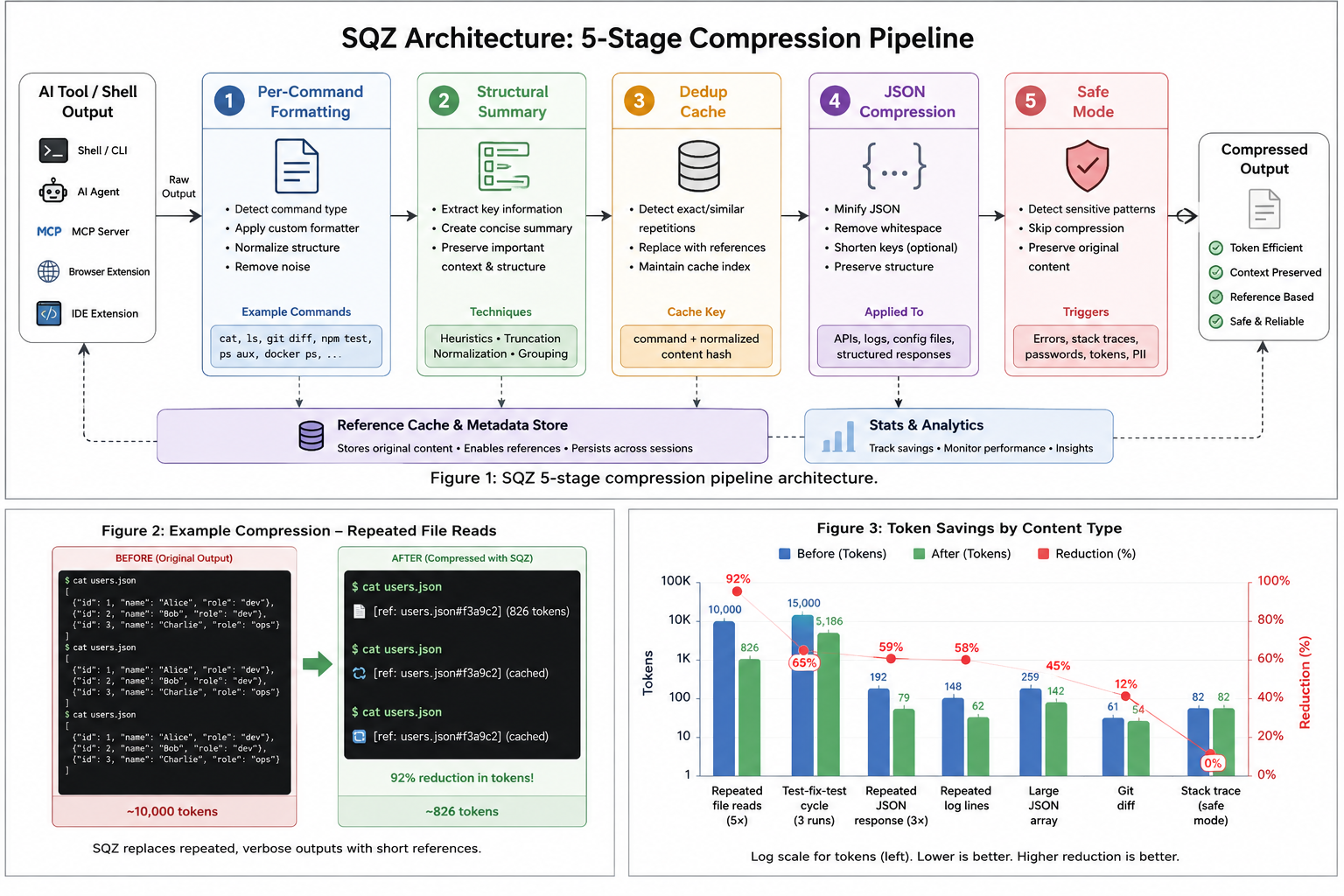
Figure 1: sqz system architecture — integration surfaces, 8-stage compression pipeline, and supporting subsystems.
On frameworks that have one, sqz operates as a PreToolUse hook: a command the agent framework invokes before a shell tool call runs, which rewrites the command so its output passes through sqz before it reaches the model. The system comprises four integration surfaces (CLI Hook, MCP Server, Browser Extension, IDE Extension) feeding into a unified Rust core (sqz_engine) with an 8-stage compression pipeline. Three supporting subsystems handle persistence (SHA-256 cache, SQLite FTS5 store, CTX session graph), intelligence (TOON lossless encoder, AST parser supporting 18 languages, model router), and analytics (USD cost tracking, multi-agent budgets, correction log). The entire system operates with zero telemetry, fully offline, and is air-gap capable.
The architecture has five logical stages:
2.1 Domain-Specific Structural Formatters
Rather than treating all text uniformly (as token-level compression methods do), sqz has per-command formatters (git, cargo, npm and its relatives, pytest, go, gradle, maven, dotnet, docker, kubectl describe/apply, terraform, grep and others) and applies format-aware transformations:
- Test output → failures only (passing tests stripped)
- Git status → compact change summary
- JSON responses → fields that are null or an empty string, array or object stripped, bookkeeping fields (
__v,etag, request and correlation ids) dropped, strings over 500 characters cut, arrays of objects written as lossless TOON tables - Docker → compact
docker psanddocker imagestables;kubectl getandlogsgo through the generic pipeline - Build logs → error-focused summarization
This exploits the observation from CodeComp [7] that source code and structured outputs have formal semantics governed by structure rather than surface-level co-occurrence. A cargo test output of 500 lines can be faithfully represented by 30 lines containing only the failures and their locations.
2.2 Content-Addressed Deduplication
Agentic sessions exhibit high repetition: the same file is read multiple times, the same command re-run after edits, the same API response fetched across turns. sqz maintains a persistent SHA-256 content cache (surviving across process invocations via SQLite) and replaces repeated content with a 13-token reference marker (§ref:HASH§).
This is analogous to the demand paging concept described in [8], where context content is loaded on-demand rather than kept resident. The key insight is that in coding sessions, the dominant savings come not from compressing individual outputs harder, but from recognizing that the same content appears repeatedly.
A reference is only emitted while the content it points at is plausibly still in the model’s context: refs expire after a freshness window (30 minutes of wall-clock time by default) and are invalidated eagerly when the agent framework compacts its history, at which point the content is re-sent in full. As of 1.4.0, entries can also be pinned (sqz pin), exempting them from the freshness check — useful for stable knowledge-base content (project docs, system prompts) that multiple agents sharing the session store reference across days.
Near-duplicate deltas. A file re-read after a small edit is not byte-identical, so exact hashing misses it. sqz detects near-duplicates of cached entries and emits a line-level delta: the changed lines with one unchanged line on each side, plus a reference to the version the model already has. Deltas come from the sqz MCP tools and the MCP proxy; the shell hook path has none, so a file re-read with cat after an edit is sent in full. Since 1.5.0 a session-lifetime MinHash LSH index selects delta candidates, so a file re-read late in a long session still matches its earlier version rather than only the most recent cache entries.
Ranged (slice) references, 1.8.0. A field measurement over one user’s real Claude Code sessions (measurement script published [15]; counters reset at each compaction boundary, edit/write confirmations excluded) found that byte-identical repeats were rare (0.3% of result characters; 1 in 542 file reads) but 8.4% of file reads were a line range of a file already read in full — sed -n '41,80p' after cat, or a ranged read tool call. Exact hashing misses these entirely, and near-duplicate matching does too: a 40-line slice of a 500-line file has a Jaccard similarity near 0.1. sqz therefore checks containment: when new output is, on line boundaries, a slice of a fresh full read whose served bytes also contain the slice, it emits §ref:HASH:L41-80§ instead of the lines. The second condition matters — the slice must appear in what was actually delivered to the model, so a ranged reference can never point at lines a lossy stage dropped. Guards: at least 160 bytes and two lines, and the same freshness and compaction rules as whole-content refs. The reference is not a summary; it is a pointer to bytes the model already holds, and sqz expand 'HASH:L41-80' recovers exactly those lines on demand.
Measured empirically: dedup accounts for 92% reduction on repeat reads, compared to 11.5-73.6% from first-pass compression on the engine benchmark inputs (benchmarks.rs, excluding the stack trace and prose rows).
2.3 Adaptive Pressure-Aware Compression
Inspired by research on adaptive compression rate allocation [9, 10], sqz dynamically adjusts compression intensity based on session pressure — the rate of token injection over a sliding window:
- Low pressure (<50% of estimated budget consumed in 30 minutes): Default mode, preserve maximum detail
- High pressure (>80%): Escalate to aggressive compression, accepting higher information loss
- Critical (>90%): Maximum compression + proactive dedup
This implements the core finding from ACC-RAG [10] that static compression rates are suboptimal: early in a session detail preservation matters more, while late in a session token scarcity demands harder compression.
2.4 Pattern-Based Safety Routing
Not all content should be compressed. Stack traces contain exact line numbers that compression could corrupt. Configuration files with credentials should not be parsed and reformatted. Migration SQL must be preserved byte-exact.
sqz classifies content into risk tiers with pattern checks, plus an entropy measure that separates boilerplate from normal content:
- Safe mode: stack traces with their frames (a Rust
stack backtrace:with numbered frames, a PythonTracebackwithFilelines, JVM and JavaScriptatframes, Go goroutine dumps), PEM blocks, credential lines (key=valueorkey: valuewith a secret-looking key), SQL DDL at the start of a line. These checks match whole lines, so a log line or commit message that only mentions a password or a panic does not qualify. Safe-mode content passes through unchanged at any size and is never cached. On the shell hook a per-command formatter still runs first and may summarize the rest of a test run around such content, but its summary is used only when it keeps every line of the paragraphs that hold it. Output that only mentions such markers is compressed as usual but is not cached either, so anything a lossy stage drops from it cannot be expanded. - Default mode: Normal code, git output, build logs
- Aggressive mode: content with very low average entropy, such as repetitive logs and boilerplate; it currently runs the same pipeline as default mode
This addresses the concern raised in [11] that compression methods which rely on generic importance metrics can inadvertently remove functionally critical tokens.
Version 1.4.0 extended the safety model with three fidelity guarantees derived from field reports:
- Byte-faithful file reads. The MCP file tools (
sqz_read_file,sqz_grep,sqz_list_dir) bypass every content-altering pipeline stage — a file read returns its bytes verbatim apart from ANSI stripping. Token savings on this path come exclusively from dedup references on repeat reads, never from dropping content. (Previously, entropy truncation could silently remove below-median-entropy segments from source files.) - Refuse-to-guess formatting. Structural formatters bail out to raw passthrough rather than emit a partial or misclassified summary. The
git statusformatter, for example, parses porcelain output strictly, matches localized long-format section headers against git’s own translation files (it/de/fr/es/pt_PT), and passes any unrecognized locale or section through unmodified — a wrong summary is strictly worse than no compression. - UTF-8 boundary safety. All truncation and splitting of user-controlled text rounds to character boundaries, so densely non-ASCII output (Cyrillic, CJK, Arabic, emoji) can never crash the compressor mid-pipeline; the property is enforced by randomized tests over arbitrary strings and cut points.
2.5 N-gram Abbreviation
For session-level compression beyond dedup, sqz observes recurring multi-token phrases across the session and introduces compact abbreviations. This technique is inspired by BPE (Byte Pair Encoding) applied at the output level rather than the tokenizer level — frequently co-occurring phrases are replaced with shorter representations.
Abbreviation is deliberately lossy for identifiers: only the first occurrence of a repeated phrase survives verbatim, so a commit SHA or file path embedded in a repeated phrase would be replaced by its abbreviation symbol on later lines. Since 1.4.0 the technique is opt-out (--no-abbrev or SQZ_NO_ABBREV=1, mirroring the dedup opt-out) and the generated agent guidance documents the escape hatch, so an agent that needs to copy-paste identifiers verbatim can disable it per command.
3. Integration Model
Unlike prompt compression tools that require API interception or model-specific adapters, sqz integrates at the tool execution boundary: through a hook where the framework has one that can rewrite tool calls, and through agent guidance plus an MCP server where it does not:
| Framework | Hook Mechanism |
|---|---|
| Claude Code | PreToolUse JSON hook (Bash and PowerShell tools) + PostToolUse hook (Bash) + MCP server |
| Cursor | .cursor/rules/sqz.mdc guidance |
| Windsurf | .windsurf/rules/sqz.md guidance |
| Cline / Roo Code | .clinerules guidance |
| Kiro | .kiro/steering guidance + .kiro/settings/mcp.json MCP entry |
| Gemini CLI | BeforeTool hook |
| OpenCode | TypeScript plugin + opencode.json MCP entry |
| Codex | AGENTS.md guidance + config.toml MCP entry |
| Zed | .rules/AGENTS.md instructions + context_servers MCP entry |
| Copilot CLI | preToolUse hook |
| Any MCP server | sqz-mcp proxy wrapper (since 1.6.0) |
A single sqz init command detects installed frameworks and configures each one. On Claude Code, Gemini CLI, Copilot CLI and OpenCode the integration is transparent: the hook or plugin rewrites shell commands, and the agent receives compressed output without doing anything. On Kiro, Codex, Zed, Cursor, Windsurf and Cline it is advisory: sqz saves tokens only when the agent pipes output through sqz compress or calls the sqz MCP tools, and the client’s built-in shell and file tools bypass it. sqz doctor reports each client’s tier.
Since 1.6.0 the MCP proxy provides a framework-independent integration surface: sqz-mcp proxy -- <upstream command> wraps any stdio MCP server, compresses its tool results through the full pipeline (dedup references on repeats, safe mode for stack traces and secrets, error results untouched), optionally compacts verbose tool descriptions in tools/list, and injects an sqz_expand tool so the agent can recover any cached original byte-exact. The client sees a normal MCP server, so this works with every MCP client regardless of whether it supports hooks.
4. Evaluation
4.1 Token Savings
Measured across a real developer’s week of agentic coding (3,003 compressions):
| Metric | Value |
|---|---|
| Total compressions | 3,003 |
| Tokens in (original) | 721,840 |
| Tokens out (compressed) | 543,398 |
| Tokens saved | 178,442 |
| Average reduction | 24.7% |
| Peak reduction (dedup) | 92% |
4.2 Per-Category Performance
The first four rows are repeats through the shell hook path (sqz compress --cmd, release binary, fresh database), counted in cl100k tokens of everything the agent sees: the reference plus sqz’s one-line note on stderr. The other rows are single compressions from cargo test -p sqz-engine benchmarks, counted in chars/4.
| Content Type | Before | After | Reduction |
|---|---|---|---|
Same cargo test output again | 366 | 39 | 89% |
| Lines 41-80 of a 200-line file read earlier | 260 | 35 | 87% |
Unchanged git status again | 166 | 37 | 78% |
| Same JSON API response again | 165 | 42 | 75% |
| Repeated log lines | 148 | 39 | 74% |
| Large JSON array | 259 | 111 | 57% |
| Git diff | 61 | 54 | 11% |
| Stack trace (safe mode) | 82 | 82 | 0% |
4.3 Prompt Cache Impact
Because sqz operates pre-injection (before content enters the context), the message prefix used for prompt caching remains unchanged. This is a critical advantage over post-hoc pruning methods which modify history and invalidate cached prefixes.
4.4 Latency
sqz is implemented as a single Rust binary with zero runtime dependencies. On an Apple M4 Pro, a sqz compress call takes 39.1-43.2 ms p50 end to end for outputs up to 10 KB (p99 43.1-52.7 ms), and most of that is fixed cost: about 13 ms of process start (sqz --version p50 12.9 ms) and about 22-25 ms to build the cl100k tokenizer. Warm and in process, SqzEngine::compress has a p99 under 3.1 ms up to 10 KB and 18.4-26.3 ms at 100 KB, except JSON at 76.5 ms. End to end, a call takes 76.0-85.5 ms p50 at 100 KB and 329.8-525.2 ms p50 at 1 MB, depending on content.
5. Related Work
Prompt Compression. LLMLingua [2] and LLMLingua-2 [3] achieve 2-20× compression by removing non-essential tokens using a small classifier model. These operate on the entire prompt (system + user + history) and require an additional LLM inference pass. sqz differs by targeting only tool outputs, requiring no LLM call, and operating at the structural rather than token level.
Context Pruning. ACON [6] optimizes compression guidelines for long-horizon agents by analyzing failure trajectories. Dynamic Context Pruning [5] manages conversation history post-hoc. These complement sqz — they handle what’s already in context, while sqz reduces what enters context.
Structural Compression for Code. CodeComp [7] demonstrates that attention-only compression discards structurally critical tokens (call sites, branch conditions). sqz’s domain-specific formatters address this by understanding output structure rather than relying on statistical importance.
Information-Theoretic Perspectives. [12] frames compressor-predictor systems through mutual information, showing that larger compressors are more token-efficient. sqz is consistent with this framework — it functions as a deterministic, zero-parameter “compressor” that maximizes information per token through structural awareness rather than learned compression.
Structurally Lossless Trimming. [13] introduces a three-pass algorithm that strips mechanical bloat (raw tool outputs, base64 images, metadata) while preserving user messages verbatim, achieving up to 86% reduction. sqz operates at a complementary point — before injection rather than during trimming — but shares the insight that tool outputs are the dominant source of context bloat.
6. Limitations and Future Work
- Token counting: the compression pipeline counts tokens with real BPE tokenizers (tiktoken
o200k_basefor OpenAI models — exact;cl100k_baseas a ~5%-variance approximation for Claude and Gemini; chars/4 for unknown local models). The dedup fast path and MCP-side estimates still use the chars/4 heuristic for latency, so aggregate savings figures mix exact and approximate counts. - JSONC round-trip: For tools using JSON-with-comments configs, programmatic merging cannot preserve comments. sqz warns before merging OpenCode configs and refuses to rewrite Zed settings files entirely, printing a copy-paste snippet instead — safe, but it leaves one manual step for those users.
- No semantic compression: sqz does not use an LLM to summarize content. This is by design (no model call, zero cost, deterministic), but means it cannot capture semantic redundancy across structurally different outputs.
- Dedup granularity: exact whole-content hashing, line-aligned slice containment (1.8.0), and near-duplicate deltas via MinHash LSH [14] (1.5.0) cover identical, ranged, and lightly-edited re-reads. Overlaps that are not line-aligned, and structural duplicates across different serializations (the same record fetched once as JSON and once as a table), still re-send in full.
Future directions include structural dedup across serializations, integration with KV cache compression methods [7], learned formatters that adapt to project-specific output patterns, and an end-to-end evaluation measuring agent task success with and without compression rather than token counts alone.
7. Conclusion
sqz demonstrates that significant token savings (24.7% average, 92% on dedup hits) are achievable through pre-injection structural compression, without model fine-tuning or additional LLM calls. By operating at the tool output boundary, sqz is framework-agnostic, cache-friendly, and transparent on frameworks with a rewrite hook. The combination of domain-specific formatters, content deduplication, and adaptive pressure-awareness produces a practical system that reduces costs and improves session longevity for real-world agentic coding workflows.
References
[1] T. Pan, “Tool Output Compression: The Injection Decision That Shapes Context Quality,” 2026. Available: https://tianpan.co/blog/2026-04-20-tool-output-compression-context-injection
[2] H. Jiang, Q. Wu, C.-Y. Lin, Y. Yang, and L. Qiu, “LLMLingua: Compressing Prompts for Accelerated Inference of Large Language Models,” in Proc. EMNLP, 2023. arXiv:2310.05736
[3] Z. Pan et al., “LLMLingua-2: Data Distillation for Efficient and Faithful Task-Agnostic Prompt Compression,” in Proc. ACL Findings, 2024. arXiv:2403.12968
[4] X. Wang et al., “Lightning-fast Compressing Context for Large Language Model,” in Proc. EMNLP Findings, 2024. arXiv:2406.13618
[5] “Dynamic Context Pruning for Efficient and Interpretable Autoregressive Transformers,” arXiv:2305.15805, 2023.
[6] “Optimizing Context Compression for Long-horizon LLM Agents (ACON),” arXiv:2510.00615, 2024.
[7] Q. Chen, J. Xiong, C. Zhao, S. Yang, and N. Wong, “CodeComp: Structural KV Cache Compression for Agentic Coding,” arXiv:2604.10235, 2025.
[8] “Demand Paging for LLM Context Windows,” arXiv:2603.09023, 2025.
[9] “Developing Adaptive Context Compression Techniques for Large Language Models in Long-Running Interactions,” arXiv:2603.29193, 2025.
[10] “Enhancing RAG Efficiency with Adaptive Context Compression (ACC-RAG),” arXiv:2507.22931, 2025.
[11] “When Goal-Gradient Importance Meets Dynamic Skipping,” arXiv:2505.08392, 2025.
[12] “An Information Theoretic Perspective on Agentic System Design,” arXiv:2512.21720, 2024.
[13] “DAG-Based State Management and Structurally Lossless Trimming for LLM Agents,” arXiv:2602.22402, 2025.
[14] “MinHash LSH in Milvus: The Secret Weapon for Fighting Duplicates in LLM Training Data,” Milvus Blog, 2025.
[15] harrison001, “Count repeated tool output in Claude Code logs: byte-identical repeats and slice re-reads (containment),” GitHub Gist, 2026. Available: https://gist.github.com/harrison001/76250b61ad665bf9a377e7096dffdbe0
Citation
@software{sqz2026,
  author = {Chugh, Ojus},
  title = {sqz: Pre-Injection Context Compression for Agentic Code Generation},
  year = {2026},
  url = {https://github.com/ojuschugh1/sqz},
  version = {1.8.0}
}
sqz is open source, dual-licensed under MIT and Apache 2.0. Source code, benchmarks, and documentation available at github.com/ojuschugh1/sqz.